We use cookies to enhance your experience. Essential cookies are required.
Selecting Cold Weather PPE: A Strategic Guide to Winter Work Gloves and Apparel
Find cold weather work gloves for construction workers and winter PPE that support safe, compliant outdoor work in wet, windy, and freezing conditions.
Read More
Mitigating environmental hazards in industrial and construction settings requires a calculated approach to equipment selection. When temperatures drop, Safety Managers, EHS Directors, and Procurement teams must evaluate cold weather PPE that protects personnel from environmental extremes without compromising protection against mechanical, chemical, or electrical hazards. The objective is to deploy winter PPE that ensures continuous operational productivity, regulatory compliance, and maximum injury prevention across highly variable worksites.
Industrial PPE programs must account for the compounding risks introduced by cold weather. Cold stress can rapidly degrade motor skills, reducing hand dexterity and increasing the likelihood of dropped objects, slips, and severe injuries. At the same time, over-insulating workers or providing inadequate moisture management can lead to sweat accumulation, which rapidly accelerates heat loss when physical activity stops. Selecting the correct cold weather work gloves for construction workers, maintenance personnel, and utility operators requires evaluating thermal insulation, waterproof membranes, hazard-specific ANSI ratings, and high-visibility requirements.

The Foundations of Cold Stress Prevention
Cold stress conditions—which can lead to hypothermia, frostbite, and trench foot—are dictated by ambient temperature, wind chill, and moisture. To control these risks, occupational safety standards emphasize a structured approach to protective clothing, commonly known as the three-layer system. Implementing this methodology correctly is critical for maintaining core body temperature while allowing for the physical exertion inherent in industrial labor.
The Three-Layer System
The efficacy of winter PPE relies on proper layering to manage internal moisture and block external elements.
Moisture-Wicking Base Layer
The layer closest to the skin must transport sweat away from the body. Synthetic fabrics or specialized natural fibers like merino wool are essential. Cotton must be strictly avoided, as it absorbs and retains moisture, effectively creating a cold thermal bridge directly against the skin.
Insulating Layer
The middle layer is designed to trap body heat. Fleece lining, synthetic down, or specialized thermal liners provide the necessary dead air space to retain warmth without adding excessive bulk that might restrict movement.
Windproof Outer Layer
The exterior shell must protect against environmental penetration, acting as a barrier to wind and precipitation. A breathable membrane is often integrated into this layer to allow internally generated moisture to escape while preventing rain or snow from entering.
Critical Evaluation Criteria for Cold Weather Work Gloves
Hand injuries remain one of the most frequent occupational hazards in industrial environments. Specifying cold weather work gloves for construction workers and industrial operators involves balancing thermal protection with necessary mechanical safeguards. Safety coordinators must evaluate several distinct components when standardizing glove SKUs.
Thermal Insulation and Moisture Barriers
Effective winter gloves utilize advanced lining technologies to maintain warmth in freezing temperatures. Materials such as Insulcore® thermal lining provide high-efficiency heat retention. For wet environments, water-resistant shells or fully integrated waterproof barriers are necessary. The Aquagard® waterproof membrane is frequently specified in winter gloves to block external moisture while maintaining internal comfort. Additionally, specialized finishes like HPT water-repellent coatings prevent the outer shell of the glove from absorbing water and freezing solid.
Mechanical Hazard Mitigation: Cut and Impact Ratings
Cold weather does not eliminate the risk of lacerations or crush injuries; in many cases, numb hands and slippery surfaces increase these risks. Winter gloves must carry appropriate ANSI/ISEA 105 cut ratings and ANSI/ISEA 138 impact ratings for the designated task. Modern manufacturing allows for high-level cut protection to be seamlessly integrated with thermal linings. Shell materials like Hyperon® or DuraBlend® offer robust cut resistance, while the M-Force Defense System® provides localized protection against back-of-hand impacts without severely restricting flexibility.
Hand Dexterity and Grip Performance
Bulk is the primary enemy of hand dexterity. If a glove is too thick, workers will inevitably remove it to perform tactile tasks, instantly exposing them to cold stress and mechanical hazards. High-gauge machine-knit gloves combined with specialized palm coatings ensure workers maintain tactile feedback. Coatings such as NitriX® Grip Technology, VersaTek Grip®, or sandy latex ensure secure material handling in wet, icy, or oily conditions.
Standardizing Winter Glove Selections by Application
Because industrial operations involve diverse tasks, rotating personnel, and non-routine work, establishing a standardized catalog of versatile, standards-compliant PPE is highly recommended. The following glove profiles demonstrate how specific combinations of liners, shells, and coatings can be deployed to meet various hazard assessments.
Heavy-Duty Impact and Cut Protection
For heavy construction, oil and gas extraction, and rigging applications, extreme mechanical protection must be paired with weather resistance.
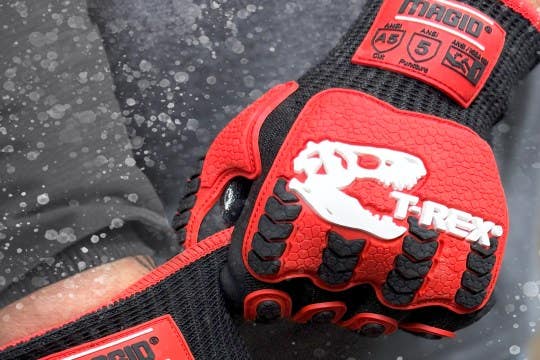
- TRX540W: Features a NitriX® Grip Technology palm and a DuraBlend® shell lined with Insulcore® thermal insulation. It includes the M-Force Defense System® and an Aquagard® waterproof membrane. This glove delivers ANSI Cut Level A5 and ANSI Impact Level 2 protection, alongside high-visibility coloring for visual compliance checks.
- TRX843W: Designed for environments involving heavy fluids, this glove utilizes a water and oil-repellent goatskin leather shell over a para-aramid liner and Insulcore® thermal lining. Equipped with the M-Force Defense System®, it achieves an ANSI Cut Level A6 and ANSI Impact Level 2 rating.
High-Dexterity and Precision Tasks
Maintenance workers, electricians, and equipment operators require maximum tactile sensitivity alongside cold weather protection.
- BP200W: Utilizing a 15-gauge nylon shell with a double-layer Insulcore® thermal lining and a foam nitrile palm, this glove offers exceptional flexibility. It features an HPT water-repellent finish, achieving an EN511 Contact Cold Level 2 rating alongside an ANSI Cut Level A2 rating.
- TRX526W: Built on a 15-gauge Hyperon® shell with a natural Merino wool liner and a foam nitrile palm. It incorporates a low-profile impact 1 design and is water-repellent, delivering ANSI Cut Level A5 and ANSI Impact Level 1 protection without excessive bulk.
Extreme Cut Hazards
When operations involve handling highly abrasive materials, sheet metal, or sharp debris in freezing conditions, cut resistance must be maximized.
- GPD954W: Provides the highest level of cut protection available, achieving an ANSI Cut Level A9 rating. It pairs a Hyperon® shell with a sandy latex palm for secure grip, utilizing an acrylic and Insulcore® thermal lining to protect against the cold.
General Purpose and High-Visibility Environments
For general site work, warehousing, and logistics, cost-effective versatility and visibility are paramount.
- HV250W: A 13-gauge 100% polyester glove featuring Insulcore® thermal lining, an Aquagard® waterproof membrane, and a NitriX® Grip Technology palm. The high-visibility design aids in site safety, while providing ANSI Cut Level A4 protection.
- GP400W: Positioned as an optimal value option for general applications, featuring a 10-gauge acrylic shell with Insulcore® thermal lining and a latex palm. It offers ANSI Cut Level A2 protection and is designed to hide dirt, extending the usable life of the PPE.
Dual-Hazard Outerwear for Extreme Industrial Environments
While gloves protect the extremities, core body temperature must be preserved through appropriate industrial outerwear. In specialized sectors such as petrochemicals, electrical utilities, and volatile manufacturing, standard winter jackets represent a severe liability due to the risk of arc flash or flash fire. Synthetic materials commonly used in consumer winter clothing can melt into the skin when exposed to high heat or electrical arcs.
To maintain cold weather safety in these specific environments, safety programs must integrate dual-hazard protective clothing. For example, the Magid Dual-Hazard Quilt-Lined Duck Outerwear line—which includes bib overalls (OVR11B/OVR11N), bomber jackets (BOM11B/BOM11N), and parkas (PRK11B/PRK11N)—provides a comprehensive solution.
Constructed with a 13 oz 100% FR (Flame Resistant) cotton fabric outer shell, these garments feature a tight weave designed to protect against penetrating wind and water. The interior features a quilted 100% FR cotton lining, adding critical thermal insulation without introducing melting hazards. Crucially for EHS compliance, the outer shell and all trims are UL certified to NFPA 2112 standards for flash fire protection. Furthermore, the garments meet NFPA 70E CAT 4 requirements, boasting an Arc Rating ATPV of 45 cal/cm². Deploying this tier of outerwear ensures that workers are insulated against severe cold stress while remaining fully compliant with stringent electrical and fire safety regulations.
Managing the PPE Program and Procurement Strategy
Developing a reliable winter safety program requires more than simply purchasing warm clothing. Safety Directors and Procurement Managers must focus on total cost of ownership, durability, and the ability to standardize PPE across diverse roles and geographic locations. Narrowly specialized solutions often complicate inventory management and reduce workforce compliance if they are not versatile enough for changing daily tasks.
Audit readiness and program consistency are persistent concerns. When evaluating suppliers and establishing approved SKU lists for the upcoming winter season, safety and purchasing teams must rely on documented product specification sheets and standardized testing data. To facilitate this level of detailed program planning, procurement teams frequently require direct access to comprehensive supplier documentation. Executing a Magid glove catalog download winter PPE file allows decision-makers to systematically review ANSI ratings, material specifications, and available sizes across all sites.
Effective deployment also requires structured workforce training. Employees must be educated on proper storage protocols—such as not leaving wet insulated work gloves in freezing trucks overnight—and the importance of keeping spare dry socks and secondary pairs of gloves accessible. Warming breaks must be scheduled in accordance with OSHA guidance to prevent prolonged exposure, regardless of the quality of the protective clothing worn.
By grounding procurement decisions in real-world hazard assessments and aligning PPE selections with specific ANSI and NFPA regulatory expectations, organizations can create scalable, defensible safety systems. Prioritizing proven material technologies like Insulcore®, Aquagard®, and high-level cut-resistant shells ensures that workers remain protected, comfortable, and productive throughout the most severe cold weather operations.